

During pregnancy, labour and after your baby is born.
You have the right to be fully informed about medical treatments and tests, and to choose whether or not you give your consent.
Informed choice in healthcare is a right that is facilitated when a person is given options for their care, including a description of any recommended procedures/medications, along with the benefits, risks and expected outcome of each option.
Informed choice
Your maternity care providers are legally required to give you information and opportunities to make informed choices about all aspects of your maternity care. They are required to give you accurate, evidence-based, unbiased information and answer any questions you have, about any tests, treatments, medications or procedures* that they are offering or recommending, including any offer or request that you participate in the training of students or research, so that you can make an informed decision about whether or not you will give consent.
Informed choice is particularly relevant to maternity care because pregnancy, labour, birth and mothering are normal physiological processes that have ensured the survival of the human species for millennia. They are not illnesses. Healthy women could, in theory, progress through these normal life processes without any medical intervention. Most women however, appreciate the monitoring that they receive from their LMCs and some need the medical treatments and procedures that are available. Some women will trust their intuitive feelings about their baby’s wellbeing and their own ability to have a healthy pregnancy, labour and birth, while others will look for reassurance and assistance from the available medical interventions.
“Informed consent is the process of exchanging information so that a patient/consumer can make an informed decision about their healthcare options, including the option of refusing the treatment, procedure or intervention.”
Source: http://www.waitematadhb.govt.nz/patients-visitors/your-safety-in-hospital/informed-consent/
*Throughout this document, the term ‘medical intervention’ will include any
or all of these types of medical procedures.

Maternity care choices
Our current model of maternity care requires that all women make choices about an ever-increasing number of medical interventions from early pregnancy onwards.
Many women do not know that they have the right to make informed choices about all the medical interventions that are offered or recommended to them, during their pregnancy, labour and birth, as well as for themselves and their babies after they have given birth.
It is your body and your baby. All medical tests have the possibility of giving you a non-reassuring and/or inaccurate result and all medical procedures and medications carry the possibility of risks or side effects. You (and your partner/whānau) will have to cope with the positive or negative outcomes of any medical intervention. You therefore have both the right and responsibility to decide what is best for you and your baby.
We are all individuals and so our decision-making processes are potentially different.
Informed choices about maternity care are made by:
- Evaluating the information that is available;
- Responding to our intuition or feelings;
- Factoring in our values, beliefs, personal history, cultural background as well as the opinions and the experiences of whānau and friends;
- Using the information sharing process to build a mutually respectful relationship with our LMCs so that we feel we can trust the recommendations s/he makes. (The LMC is still required to provide full information and the opportunity for you to consent to or refuse any medical intervention.)
Your first maternity choice
Defining your beliefs about pregnancy and childbirth.
Making informed choices will be easier if you clarify your beliefs. Your beliefs are likely to sit somewhere along the spectrum below:
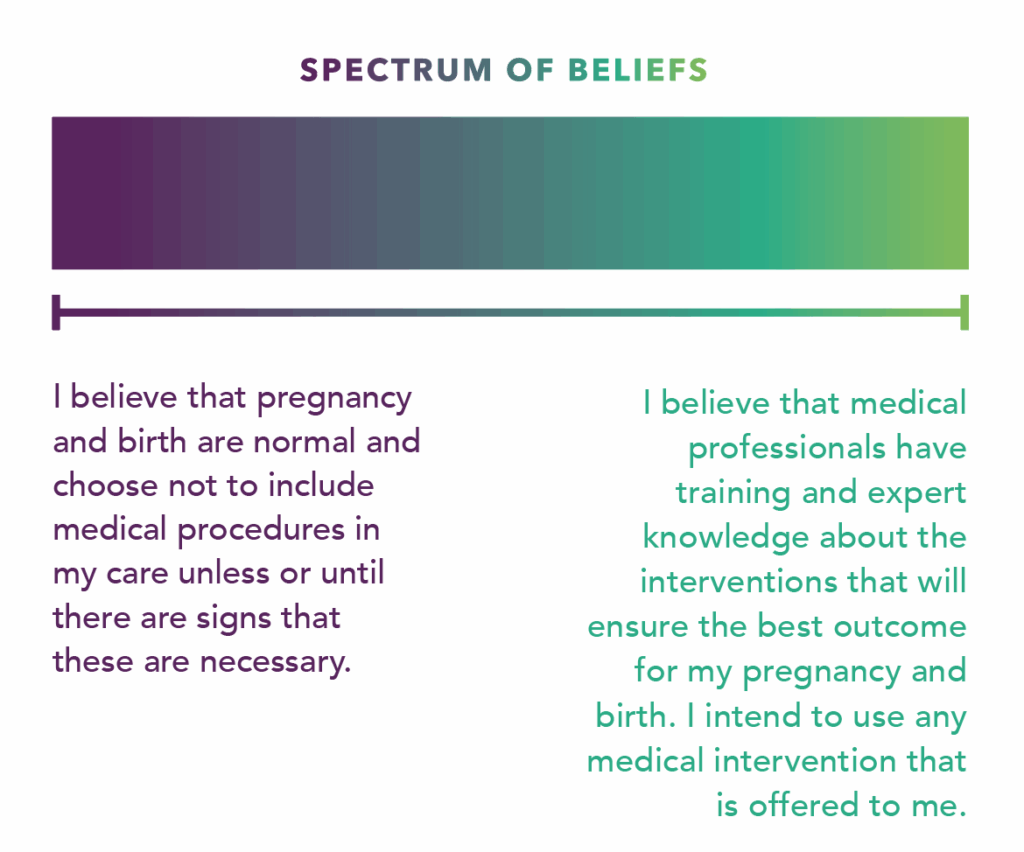
Your second maternity choice
Choosing a Lead Maternity Carer
Making informed choices will be easier if you have an LMC who respects your beliefs about pregnancy and birth. If your LMC is not willing or able, to initiate and engage in the conversations that are part of the informed choice process or to support and respect your choices, you can change to another LMC at any time.
Making informed choices
Common medical interventions that you may need to make informed choices about include:
During your pregnancy
- Choosing a Lead Maternity Carer (LMC)
- Dietary supplements, e.g. folic acid & iodine
- Blood tests (including checking for sexually transmitted infections)
- Safe food recommendations
- Genetic screening and testing
- Ultrasound scans for confirming pregnancy and estimating due date, screening for fetal anomalies and assessing fetal growth, weight and position etc.
- Screening and testing for gestational diabetes
- Place of birth: home, primary birthing unit or hospital
- Pregnancy vaccination
Labour and birth interventions
- Induction of labour
- Pain relieving drugs and epidural anaesthetic
- IV hormones to speed up labour
- Electronic fetal heartrate monitoring
- Breaking the ‘waters’ (amniotic sac)
- Forceps or ventouse assisted birth
- Episiotomy
- Early clamping and cutting of the baby’s umbilical cord
- Actively managing the delivery of the placenta
- Caesarean section
- Restricted access to skin-to-skin contact between mother and baby immediately after the birth
After the birth/postnatal choices
- Breastfeeding
- Vitamin K
- Prophylactic (just in case) antibiotics for mother or baby
- Newborn screening & testing
- Safe sleep
- Family GP
- Vaccination
Medical interventions can improve outcomes and sometimes save lives, but many have become accepted as routine by maternity care providers (MCPs) and women.
You have the right to:
- Accept or decline any test offered or recommended to you any test that you don’t want during pregnancy
- Accept or decline routine ultrasound scans during pregnancy (but you cannot have additional scans without a medical reason)
- To have a support person with you during any consultation or medical intervention
- Choose whether or not to have students involved in your care
- Choose whether or not to participate in research
- Mobility and choice of position during labour and birth
- Access to a pool during labour (and for birth) if one is available in your chosen place of birth
- Choose when and if to have internal vaginal examinations during labour and birth
- Choice of place of birth regardless of your age or if you’ve had a previous c-section
- Privacy (including deciding who can be present during your labour and birth)
- Accept or decline any routinely recommended monitoring and interventions
- Accept or decline routinely recommended interventions based on your age
- Accept or decline routinely recommended routine interventions during a vaginal birth after c-section (VBAC)
- Accept or decline routinely recommended interventions for a twin labour and birth
- Delayed cord clamping and cutting and immediate skin-to-skin contact with your baby if you have a c-section
- Challenge any care provider who tries to limit your rights by saying, “All that matters is a healthy baby”, “It’s hospital policy”, etc.
When discussing your choices with a maternity care provider, you may like to ask/say:
- What is the test or intervention called and what will it involve?
- What other medical personnel might be involved?
- Where would this medical intervention take place and how long is it likely to take?
- Is this test or intervention free or will I have to pay?
- Why are you recommending this medical intervention – is it routinely offered to all women or are you recommending it because of my symptoms/situation?
- What is the expected/desired outcome or result?
- How will this benefit me and/or my baby?
- How effective/accurate is this medical intervention?
- What would happen if the expected/desired outcome or result is not achieved?
- What are the risks and/or side effects of this medical intervention for myself and/or my baby?
- What other options/alternatives are there for managing this situation?
- If I decide not to have this medical intervention, what could happen for me and/or my baby?
- I need you to describe my options more simply. Do you have any pictures, diagrams that could help?
- I need more information before I make a decision. Can you provide me with information (pamphlets, internet links, etc)?
- How much time do I have to make a choice? Do I need to make a decision immediately? Is there time to discuss this with my partner/whānau or to get more information before making a choice?
- Please provide me with the research for this recommendation.
- I need to discuss and consider some other information (e.g. information that you’ve gathered, or that relates to your beliefs and/or your cultural background).
- I don’t feel/think what you’re recommending is right for me and my baby.
- I have changed my mind about…
- I would like a second opinion about this.
- Please give me some privacy and time to discuss and consider your recommendations with my partner/LMC/support people.

Decision-making
A decision-making model like B.R.A.I.N.S. can help ensure that you ask the questions that will give you the information you need for making informed choices about medical interventions. It can be especially helpful if other maternity care providers (MCPs) become involved in providing your maternity care
and/or you need to make an informed choice quickly.
Benefits: What are the expected benefits of this medical intervention. What is the rate of success in situations like mine/my baby’s?
Risks: What risks or side effects are associated with test, treatment or procedure? How often do these occur and how would they be managed? (NB There is no medical treatment or procedure that is free of the possibility
of risk or side effects.)
Alternatives: What alternative test, treatment or procedure is available here? What alternatives are there that might not be available here, but are available somewhere else?
Intuition: What does your instinct or intuition tell you?
Not now thanks: Could we wait and make a decision about this later? (i.e.“Watchful waiting”) OR no thanks: What could be expected if I do not consent to this test, treatment or procedure?
Second opinion: Thank you for providing me with the information and your recommendation but I would like a second opinion.
LMCs, MCPs and maternity facilities
Your LMC (and any other MCPs you receive services from) is required to give you accurate, unbiased and evidence-based information to help inform your choices.
Good quality research produces generalisations which guide recommendations for medical intervention, but cannot take into account an individual mother’s circumstances or values.
During pregnancy most women will have to make informed choices about some services that are provided by other medical personnel. Most women who choose to give birth in a hospital will have some care provided by other maternity care providers (MCPs) as well as their chosen LMC.
Mother/Parents, LMCs and MCPs all have the overall aim of a healthy outcome for mother and baby. MCPs however, are likely to recommend medical procedures that their training or experience has led them to believe will have the greatest chance of a predictable and controlled outcome. They can also be restricted by the policies and protocols in their contracts with the Ministry of Health and the maternity facilities in which they practice.
Your choices are not limited by hospital/birthing facility policies and protocols. You cannot be forced to receive a medical intervention simply because the facility protocol recommends it. MCPs cannot threaten, frighten or harass you into consenting to any medical intervention. They cannot punish you, or provide lower quality care because you have refused to consent to a recommended medical intervention. Remember, you can always ask for a second opinion.
“Life carries risks, so does pregnancy and birth. There are no zero risk choices. Today’s maternity care culture focuses on fear and has more faith in medical interventions and technology than the innate ability of women to grow, birth and mother their babies. Each woman has the right to weigh up the benefits and risks of any medical intervention and make the choice that is most acceptable to her.”
Rights and responsibilities
Care Providers’ Rights
Your LMC and any other MCP who is involved in your care is legally required to respect your informed choices.
If you decline a recommended medical intervention, your LMC/MCP may simply record your choice and continue to provide the care you have chosen. However, all MCPs have the right to refuse to continue to provide care or an intervention you request, if they believe that it will harm you, your baby or themselves professionally. In this situation, they must explain their concerns and assist you to change to a different care provider.
What you can do if you feel that your right to make informed choices has not been respected:
- You can talk to your LMC or the MCP involved and remind them of your legal rights under the Code of Health and Disability Consumers’ Rights.
- You can involve a support person of your choice in your discussions with any MCP.
- You can change to a different LMC or MCP.
- You can access a patient advocate through the nationwide Health & Disability Advocacy Service to assist you to address your issues with the maternity care provider. Phone 0800 555 050 or email [email protected]
- If the issue involves an LMC midwife, you can get assistance from a New Zealand College of Midwives Resolution Committee. www.midwife.org.nz/quality-practice/resolutions-committee
- If the issue involves a hospital employee, you can check the website of that facility and make contact with the person who is responsible for Quality and Safety/Health Consumer Experience.
- You can make a complaint directly to the Health and Disability Commissioner. Phone 0800 11 22 33, email [email protected] or use the online form at www.hdc.org.nz/making-a-complaint/complain-about-care-you-received
For more information visit www.hdc.org.nz/your-rights/about-the-code/code-of-health-and-disability-services-consumers-rights
Your legal rights
The NZ Code of Health and Disability Consumers’ Rights
The NZ Code of Health and Disability Consumers’ Rights gives you the right:
- To be treated with dignity, cultural sensitivity and respect at all times
- To choose where to give birth
- To choose your maternity care provider, and to change your maternity care provider at any time
- To choose who will be present during your labour and birth at home, in a primary birthing unit or in a hospital, and to ask anyone you don’t want present to leave
- To be given information about any side effects or risks associated with any procedure, drug/medication or test being offered or recommended
- To accept or refuse any medication or medical procedure
- To choose how you will give birth and to feel free to follow your feelings and instincts during birth
- To have your informed choices about feeding your baby fully respected and supported
- To have your baby with you from the time of birth until you are discharged from any birthing facility
- To make informed choices to accept or refuse any medical treatments or tests offered or recommended for your baby
- To make a complaint and to receive satisfactory explanations from your maternity care provider/s and others involved with your care
- To read or have a copy of your medical records and your baby’s medical records
- To have a trained interpreter if English is not your first language
- To refuse to take part in any research project or to withdraw from a research project at any time
- To refuse to allow student health professionals to provide care for you or your baby
For more details, click here to read about the code of health and disability services consumers rights.
Updated March 2024
To order your FREE pack of MSCC resources, click here.